
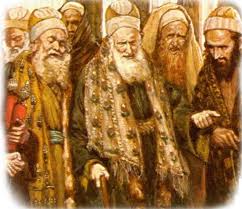
Some Sadducees, those who say there is no resurrection, came to Jesus and asked him a question, “Teacher, Moses wrote for us that if a man’s brother dies, leaving a wife but no children, the man shall marry the widow and raise up children for his brother. Now there were seven brothers; the first married, and died childless; then the second and the third married her, and so in the same way all seven died childless. Finally the woman also died. In the resurrection, therefore, whose wife will the woman be? For the seven had married her.”
Jesus said to them, “Those who belong to this age marry and are given in marriage; but those who are considered worthy of a place in that age and in the resurrection from the dead neither marry nor are given in marriage. Indeed they cannot die anymore, because they are like angels and are children of God, being children of the resurrection. And the fact that the dead are raised Moses himself showed, in the story about the bush, where he speaks of the Lord as the God of Abraham, the God of Isaac, and the God of Jacob. Now he is God not of the dead, but of the living; for to him all of them are alive.” Luke 20:27-38
Who Were the Sadducees?
The Sadducees were a small but powerful sect within Judaism during Jesus’ time. They were:
- Priestly aristocrats — wealthy, politically connected, and often aligned with Rome.
- Conservative in scripture — they accepted only the Torah (the first five books of Moses) as authoritative, rejecting later writings and oral traditions.
- Theological minimalists — they denied concepts not clearly found in the Torah, such as:
- The resurrection of the dead
- Angels or spirits
- Any form of afterlife or judgment
To them, God’s blessings were tied to this life — land, power, and prosperity were signs of divine favor.
The Sadducees came to Jesus with what they thought was an airtight question. They quoted Moses’ law about a brother marrying his deceased brother’s widow to preserve the family line and then spun it into an absurd scenario: seven brothers, one woman, no children. “In the resurrection,” they asked, “whose wife will she be?”
It wasn’t an honest question. It was a trap.
The Sadducees didn’t believe in resurrection at all, or angels, or life beyond death. They were the priestly elite: powerful, wealthy, and tightly bound to the Roman system. They prided themselves on being keepers of the law, but their “faith” was built on what they could control. For them, religion was keeping order, not about finding oneself in God.
Jesus Doesn’t Take the Bait
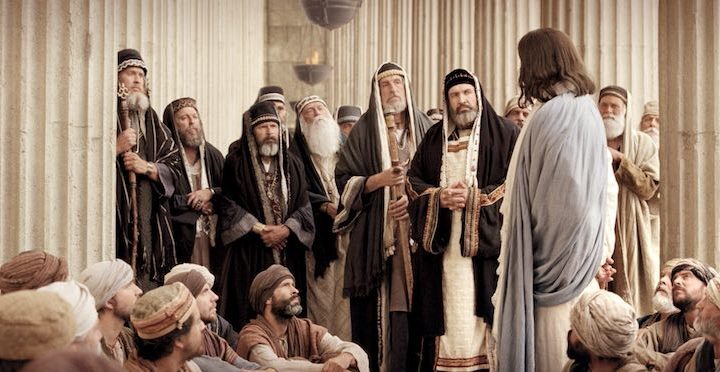
Instead of arguing, Jesus reframes the conversation entirely.
He separates this age from the age to come. “Those who belong to this age marry and are given in marriage,” He says, “but those who are considered worthy of that age… neither marry nor are given in marriage.” He isn’t dodging their question so much as He’s redirecting it. They imagine heaven as an extension of earth. Jesus reveals that resurrection is an entirely new reality, one that cannot be understood through earthly parameters. Whatever our thoughts are about what happens next, are incomplete at best.
Then He quotes their own Scriptures from the Torah, which they revered, to show that even Moses spoke of God as “the God of Abraham, Isaac, and Jacob.” And if God is the God of the living, then Abraham, Isaac, and Jacob are still alive to Him.
It’s a brilliant, loving redirection.
He doesn’t shame them for asking the wrong question. He invites them to ask a better one.
From Moralism to Love
The Sadducees were experts in the law but strangers to love. They had built their theology on control, not relationship. On moral performance rather than divine intimacy.
Moral Performance says: If I obey, I’ll be good enough for God.
Divine Intimacy says: You are loved, therefore you may freely experience all My goodness.
That shift changes everything.
When theology is built on law, it produces fear, pride, and exclusion. When theology is built on love, it produces humility, curiosity, and joy.
The Question That Changes Everything

Jesus doesn’t just correct their theology, He invites them into better thinking.
He’s not giving them a new rule; He’s revealing a new reality.
That is still His invitation to us: to move from defending our beliefs what is true.
To stop asking, “Who’s right?” and start asking, “Where can I discover God?”
To search for Christ in loving my neighbor rather than obeying church doctrine.
What if we stopped clinging to moralistic religion and started seeking the God who is love—the God not found among the dead, but among the living?
What if we oriented our theology around this simple truth:
God is love.
Everything else flows from there.